

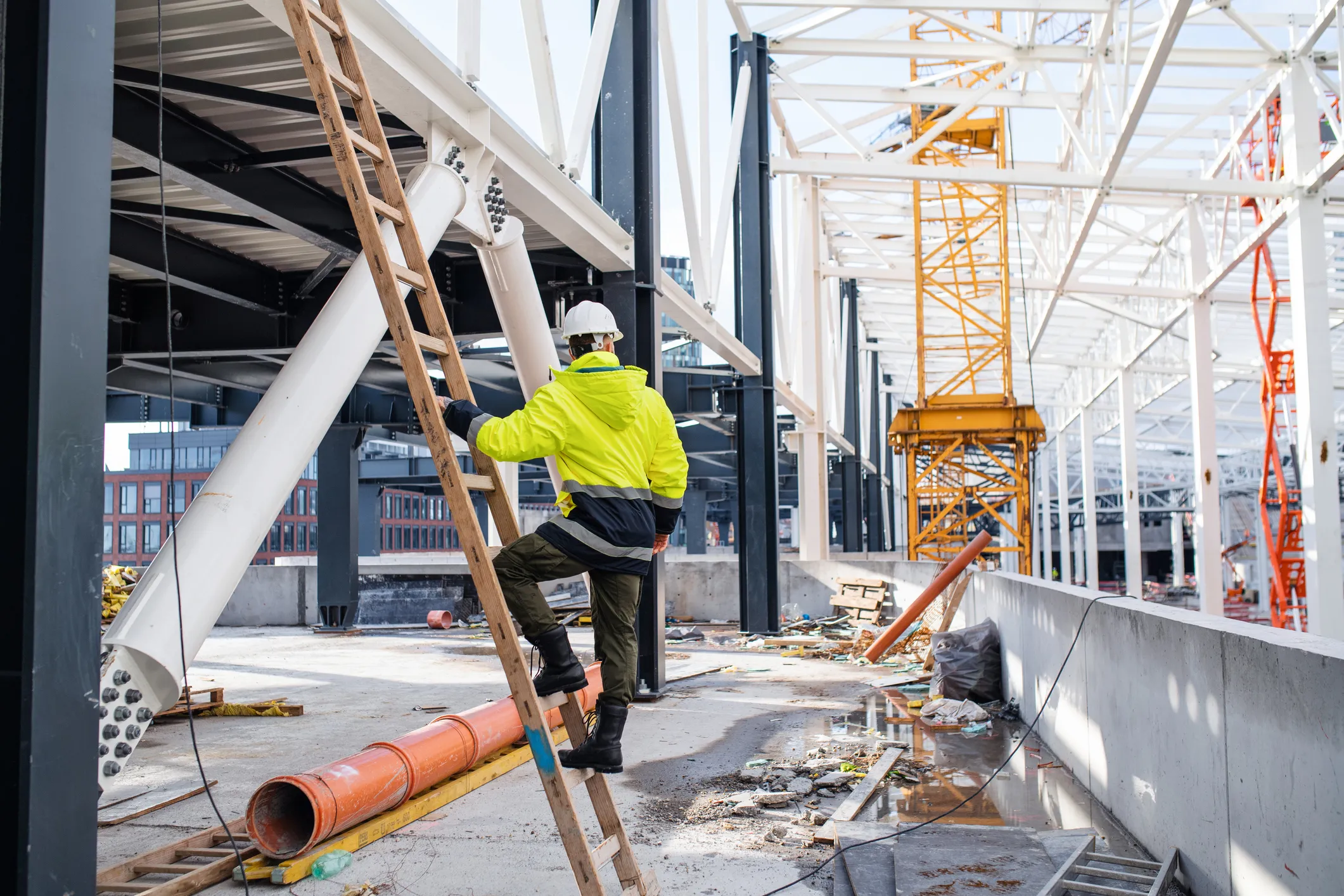
If you were injured in a fall from a ladder on a Michigan construction site, your employer’s workers’ compensation insurance may be responsible for your medical care and wage-loss benefits. You may also have the right to sue a negligent general contractor, subcontractor, property owner, ladder manufacturer, equipment company or another third party that caused the accident.
The party legally responsible depends on who provided the ladder, who controlled the work area, why the ladder failed and whether unsafe conduct contributed to the fall.
At Steele Law, we investigate Michigan construction accidents to determine whether an injured worker has a workers’ compensation claim, a third-party personal injury lawsuit or both.
Who Is Responsible for a Construction-Site Ladder Fall?
Several parties may share responsibility for a ladder accident. Potentially responsible parties include:
- Your direct employer
- A general contractor
- Another subcontractor
- The construction-site property owner
- The company that supplied or rented the ladder
- The ladder manufacturer
- A maintenance or inspection company
- Another worker or equipment operator
- An architect, engineer or construction manager
Your direct employer is generally responsible for providing workers’ compensation benefits. A separate company may be liable through a personal injury lawsuit if its negligence or defective product caused the fall.
Is My Employer Responsible for My Ladder Accident?
Your employer may be responsible for paying Michigan workers’ compensation benefits when the ladder accident arose out of and occurred during your employment.
Michigan workers’ compensation provides eligible injured employees with specified benefits, including wage replacement, reasonable and necessary medical care and vocational rehabilitation.
You generally do not need to prove that your employer was negligent to pursue workers’ compensation. However, disputes can arise over whether:
- You were an employee or independent contractor
- The accident occurred within the course of employment
- The ladder fall caused your medical condition
- Your disability prevents you from working
- Your treatment is reasonable and necessary
- You violated a clearly announced and regularly enforced workplace rule
Michigan recognizes compensation for an employee who suffers a personal injury arising out of and in the course of employment, although specific defenses and eligibility rules may apply.
Can I Sue My Employer After Falling From a Ladder?
Usually, you cannot sue your direct employer for ordinary negligence after a Michigan workplace accident.
Michigan’s Workers’ Disability Compensation Act generally makes workers’ compensation the employee’s exclusive remedy against the employer. The principal exception involves an intentional tort, which requires substantially more than carelessness, inadequate training or a safety violation.
An employer’s failure to follow a safety regulation does not automatically give the employee the right to sue the employer.
Even when a lawsuit against your employer is prohibited, you may still be able to sue another person or business that contributed to the ladder accident.
Can I Sue a Third Party After a Michigan Ladder Fall?
Yes. Michigan law allows an injured worker to pursue a third-party liability claim when someone other than the employer caused the workplace injury.
A third-party lawsuit is separate from your workers’ compensation claim. You may be able to pursue both claims at the same time.
For example, you may have a third-party claim if:
- Another contractor placed the ladder on unstable ground
- A general contractor knowingly allowed a dangerous work area to remain
- A property owner maintained control over the work and failed to address a serious hazard
- An equipment company supplied a broken or inappropriate ladder
- A manufacturer sold a defectively designed ladder
- Another subcontractor knocked the ladder over
- A forklift, crane or construction vehicle struck the ladder
- Another company created an electrical hazard near a metal ladder
Every construction project has different contracts, safety responsibilities and working relationships. The identity of your employer and the workers’ compensation insurance arrangements must also be reviewed before deciding whether a company qualifies as a third party.
Can a General Contractor Be Responsible?
A general contractor may be responsible in certain circumstances, but the general contractor is not automatically liable for every construction-site accident.
Michigan recognizes a legal theory commonly called the common work area doctrine. Under this doctrine, a worker generally must establish that the general contractor:
- Failed to take reasonable steps within its supervisory and coordinating authority
- To protect against a readily observable and avoidable danger
- That created a high degree of risk to a significant number of workers
- In a common work area
All required elements must be established.
A general contractor could also potentially be liable for its own active negligence, depending on what it did or failed to do.
Evidence showing the general contractor’s responsibility may include:
- Site-safety plans
- Contracts and subcontractor agreements
- Inspection records
- Safety-meeting documents
- Prior complaints
- Photographs of the work area
- Witness statements
- Emails and text messages
- Evidence that supervisors observed the dangerous condition
- Authority to stop unsafe work
Can the Property Owner Be Responsible?
A property owner may be responsible when the owner’s conduct, control or property conditions contributed to the accident.
Possible examples include:
- A defective floor or walking surface
- An unguarded opening
- Unstable ground
- Hidden electrical hazards
- A dangerous condition the owner knew about
- The owner directing how the work was performed
- The owner retaining sufficient control over the construction operation
Michigan law does not automatically make a property owner responsible simply because the accident happened on its property. A detailed investigation is required to establish the owner’s duty, control, knowledge and connection to the ladder fall.
Michigan courts have explained that the common work area doctrine may apply to a property owner that retains sufficient control to act in a supervisory capacity.
Can Another Subcontractor Be Responsible?
Another subcontractor may be liable when its employees or unsafe work caused the fall.
Examples include:
- A subcontractor moved the ladder while you were using it
- Materials were dropped onto or near the ladder
- Electrical wires were left exposed
- Debris made the ladder’s footing unstable
- A subcontractor removed fall protection
- Equipment struck the ladder
- Another crew created an opening or elevation hazard
- Workers placed the wrong ladder in the work area
Unlike your direct employer, another subcontractor may be treated as a third party. However, employment relationships, contractor status and insurance arrangements can complicate this determination.
Can I Sue the Ladder Manufacturer?
You may have a product-liability claim if the ladder was defectively designed or manufactured, or if adequate warnings were not provided.
Possible ladder defects include:
- Broken or weak rungs
- Defective locking mechanisms
- Collapsing extension sections
- Cracked rails
- Faulty spreader bars
- Defective feet or slip-resistant pads
- Inadequate weight capacity
- Defective hinges
- Structural weakness
- Missing or unclear safety warnings
Do not throw away, repair or alter the ladder after the accident. The ladder itself may be the most important evidence in a defective-product case.
Your attorney may arrange for the ladder to be preserved and examined by an engineer or other qualified expert.
Can a Ladder Rental or Equipment Company Be Responsible?
A rental or equipment-supply company may be liable if it provided a ladder that was:
- Damaged
- Improperly repaired
- Missing necessary components
- Inappropriate for the assigned work
- Not properly inspected
- Known to be unsafe
- Accompanied by inadequate instructions
Rental records, inspection reports, maintenance documents and prior customer complaints can help establish whether the company knew or should have known that the ladder was unsafe.
What Safety Rules Apply to Construction Ladders in Michigan?
Michigan maintains specific construction-safety standards for fixed and portable ladders under MIOSHA Construction Safety Standard Part 11.
Depending on the type of ladder and work being performed, safety concerns may include:
- Inspecting ladders for damage
- Removing defective ladders from service
- Using a ladder only for its intended purpose
- Placing the ladder on stable footing
- Securing ladders against movement
- Using the correct ladder length
- Avoiding excessive loads
- Keeping ladder areas clear
- Maintaining safe access at upper landings
- Protecting workers from electrical contact
- Providing appropriate training
- Following fall-protection requirements
OSHA also identifies falls from ladders, scaffolds and roofs as major preventable construction hazards and emphasizes planning, proper equipment and employee training.
A safety violation may provide important evidence, but it does not automatically decide who is legally responsible or guarantee compensation.
What Causes Ladder Falls on Construction Sites?
Common causes include:
- A ladder placed on uneven or unstable ground
- Broken rungs or rails
- Defective locking mechanisms
- An unsecured extension ladder
- Using a ladder that is too short
- Standing on prohibited upper steps
- Carrying heavy tools while climbing
- Reaching too far from the ladder
- Using a metal ladder near electrical wires
- Slippery rungs
- Mud, oil, water or debris around the ladder
- Improper ladder angle
- Failure to inspect the ladder
- Lack of training
- Another worker moving or striking the ladder
- A vehicle or piece of equipment hitting the ladder
- Failure to provide safer equipment such as a lift or scaffold
An investigation should examine more than whether the worker lost balance. The real question may be why the worker was required to use that ladder in that location and whether a safer method should have been provided.
What Injuries Can a Ladder Fall Cause?
Even a fall from a relatively low height can cause severe injuries, including:
- Traumatic brain injuries
- Spinal cord damage
- Paralysis
- Back and neck injuries
- Herniated discs
- Broken wrists and arms
- Shoulder injuries
- Hip fractures
- Broken legs and ankles
- Knee injuries
- Internal bleeding
- Organ damage
- Nerve damage
- Crush injuries
- Scarring and disfigurement
- Permanent disability
- Fatal injuries
Some symptoms may not appear immediately. A worker may feel pain, dizziness, confusion, numbness or weakness hours after the accident.
Seek prompt medical attention and explain exactly how the fall occurred.
What Benefits Can I Receive Through Michigan Workers’ Compensation?
Depending on the circumstances, workers’ compensation may provide:
Medical benefits
Michigan workers’ compensation may cover reasonable and necessary treatment related to the work injury, including:
- Emergency care
- Hospital treatment
- Doctor appointments
- Diagnostic testing
- Surgery
- Physical therapy
- Prescriptions
- Medical equipment
- Certain travel expenses
- Ongoing treatment
Michigan law entitles an injured worker to reasonable and necessary medical care for a compensable work injury.
Wage-loss benefits
You may qualify for wage-loss benefits when the injury prevents you from earning your pre-injury wages.
Michigan generally has a seven-day waiting period. Benefits may begin on the eighth day of disability, and if the disability continues for at least two weeks, compensation may also become payable for the first week.
Vocational rehabilitation
Vocational rehabilitation may be available when the injury prevents you from returning to your former construction job and assistance is needed to return to suitable employment.
Specific-loss or death benefits
Additional statutory benefits may be available for certain permanent losses or when a workplace accident causes a worker’s death.
What Can a Third-Party Lawsuit Pay?
A third-party lawsuit may provide compensation beyond the limited categories available through workers’ compensation.
Potential damages may include:
- Physical pain and suffering
- Emotional distress
- Loss of enjoyment of life
- Full past and future wage loss
- Reduced earning capacity
- Permanent disability
- Scarring and disfigurement
- Future medical expenses
- Loss of household services
- Loss of consortium
- Wrongful-death damages when applicable
Michigan’s third-party liability statute permits an injured employee to pursue damages against a legally responsible third party while preserving the workers’ compensation system’s reimbursement rights.
Will Workers’ Compensation Be Repaid From My Lawsuit?
Possibly.
When workers’ compensation benefits were paid for an injury caused by a third party, the employer or insurance company may assert a reimbursement interest against part of the third-party recovery.
Michigan law addresses litigation expenses, attorney fees, reimbursement and the treatment of the remaining recovery.
This does not necessarily mean that pursuing a third-party claim is not worthwhile. A lawsuit may provide categories of compensation unavailable through workers’ compensation. However, the two claims should be coordinated carefully to protect your net recovery and future benefits.
What Should I Do After Falling From a Ladder?
1. Seek medical treatment immediately
Do not try to work through severe pain, dizziness, numbness or weakness. Tell the medical provider that you fell from a ladder at work.
2. Report the accident
Notify your employer, supervisor or foreman immediately. Provide written notice whenever possible and keep a copy.
Michigan advises employees to report work injuries immediately. The statute generally calls for notice within 90 days and allows up to two years to make a claim, subject to the circumstances and statutory requirements.
3. Photograph the ladder and accident scene
Photograph:
- The entire ladder
- Damaged parts
- Ladder feet and footing
- The surface below it
- The upper landing
- Nearby electrical lines
- Tools or materials
- Missing fall protection
- Debris
- Lighting and weather conditions
- Warning labels
- The ladder’s make, model and serial number
4. Identify witnesses
Get the names, employers, telephone numbers and email addresses of everyone who saw the fall or unsafe condition.
5. Preserve the ladder
Ask that the ladder not be repaired, discarded, returned to a rental company or placed back into service. An attorney can send a formal evidence-preservation notice.
6. Keep your clothing and equipment
Preserve your helmet, boots, harness, tools and damaged clothing. Do not alter or dispose of them.
7. Do not sign a release
Do not sign a settlement agreement, release or other document until you understand how it could affect your workers’ compensation and third-party rights.
8. Contact a Michigan construction-accident lawyer
Construction sites can change within hours. Ladders may disappear, crews may leave and dangerous conditions may be repaired. An early investigation can help preserve critical evidence.
How Long Do I Have to File a Lawsuit?
Michigan generally has a three-year limitations period for personal injury actions, measured from the date of injury.
Different deadlines or notice requirements may apply depending on the defendant, the type of claim and whether a public entity or public project is involved.
Do not wait three years to begin an investigation. Evidence may disappear long before the filing deadline expires.
Frequently Asked Questions
Can I receive workers’ compensation if the ladder fall was partly my fault?
Possibly. Workers’ compensation generally does not require you to prove employer negligence. However, allegations involving intentional misconduct or violation of a clearly announced and regularly enforced rule may create disputes.
Fault can also affect a separate third-party lawsuit.
What if my employer says I am an independent contractor?
The label placed on you does not always determine your legal status. Michigan considers the actual working relationship and other statutory factors. An allegedly independent worker may still qualify as an employee.
What if my employer did not carry workers’ compensation insurance?
The available remedies depend on the employment and contracting relationships. Michigan law may impose workers’ compensation responsibility on a principal contractor in certain situations involving an uninsured contractor or subcontractor.
Can I sue if another worker knocked over my ladder?
You may have a claim against another company if that worker was employed by a different contractor. If the person was your coworker, workers’ compensation exclusivity and other immunity rules may affect the claim.
What if the ladder was supplied by my employer?
You may still receive workers’ compensation benefits. A separate product-liability claim may also exist if the ladder contained a manufacturing or design defect, although ownership alone does not prove that the manufacturer was negligent.
What if there were no witnesses?
You may still have a valid claim. Photographs, medical records, incident reports, job-site documents, surveillance video, electronic communications and physical evidence can help establish what occurred.
What if I was not using fall protection?
The effect depends on the work, ladder type, height, applicable safety standards, training and who was responsible for providing proper equipment. Do not assume that the absence of fall protection automatically eliminates your claim.
Can I sue if the general contractor violated a MIOSHA rule?
A safety violation may be important evidence, but it does not automatically establish a civil lawsuit. The general contractor’s duties, control, conduct and the legal requirements of the claim must still be proven.
Injured in a Michigan Construction-Site Ladder Fall? Call Steele Law
A ladder fall can leave you unable to work while medical bills, lost income and uncertainty continue to grow. Do not assume workers’ compensation is your only option.
At Steele Law, we investigate construction accidents to determine:
- Who supplied the ladder
- Who controlled the work area
- Whether safety rules were violated
- Whether the ladder was defective
- Whether another contractor caused the fall
- Whether you can pursue workers’ compensation, a third-party lawsuit or both
Evidence can disappear quickly from an active construction site. The ladder may be repaired, returned, discarded or used by another crew.
Do not wait. The sooner you call us, the sooner we can begin protecting your rights and preserving evidence.
Call Steele Law today at 248-704-2542 for a free consultation about your Michigan ladder-fall claim.